
C. INTERNET ACCESS TECHNOLOGIES
The type of internet connection determines the available speed, latency and reliability of the connection. The choice depends mainly on geographical location and the available infrastructure.
1. ADSL — Asymmetric Digital Subscriber Line
ADSL (Asymmetric Digital Subscriber Line) was the dominant broadband access technology in France from 2000 to 2015. It uses the existing copper telephone pair (local loop) to carry high-speed data, utilising the frequency band above that used for voice (0–4 kHz).
ADSL is a transmission technology (physical layer) that must be supplemented by data transport protocols (IP packets or ATM cells). The bandwidth of the copper pair is divided into three channels:
· Downstream channel: occupies the upper part of the band (up to 1.1 MHz) at high speeds (up to 8 Mbps for ADSL, 24 Mbps for ADSL2+).
· Upstream channel: intermediate band (25–138 kHz) with medium bit rate (512 kbps to 1 Mbps).
· Voice channel: low-frequency band (0–4 kHz) for standard analogue telephony (POTS).
|
Downstream data rate |
Distance between subscriber and NRA |
|
one and a half megabits per second |
6 km |
|
two megabits per second |
5 km |
|
six megabits per second |
4 km |
|
9 Mbps |
3 km |
|
Thirteen megabits per second |
1.5 km |
|
Twenty-six megabits per second |
1 km |
|
52 Mbps |
300 m |
2. ADSL2+ and future developments
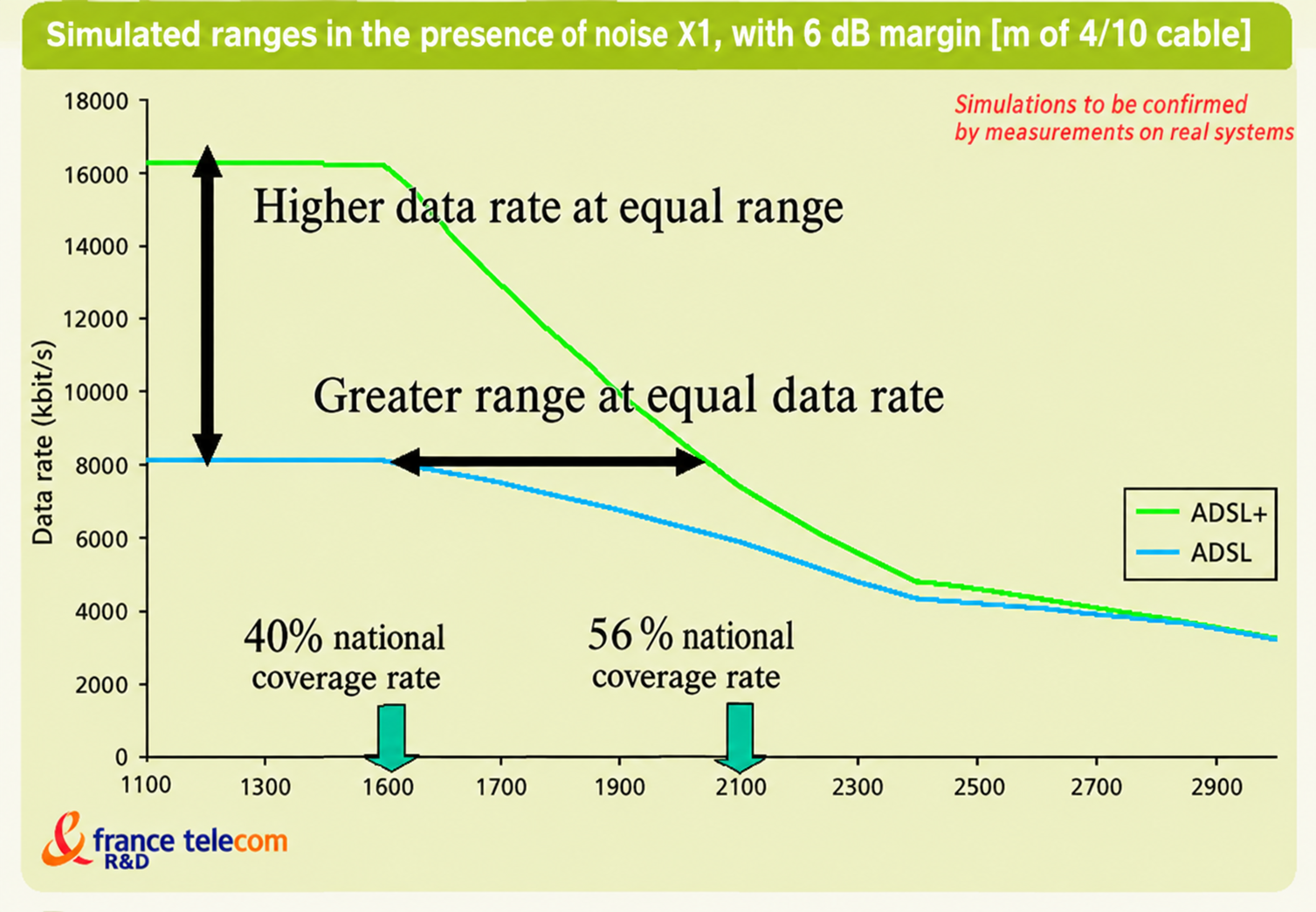
Fig. 5 — ADSL / ADSL2+ / RE-ADSL comparison: speed as a function of distance
ADSL2+ doubles the bandwidth used (spectrum up to 2.2 MHz instead of 1.1 MHz), bringing the maximum download speed to 24 Mbps for subscribers close to the exchange, at the cost of a slightly reduced range. RE-ADSL (Reach Extended ADSL) improves coverage in remote rural areas at the expense of maximum speed.
⚠ ADSL — on the way out
In France, ADSL is gradually being phased out in areas covered by fibre-to-the-home (FTTH). Orange has announced that the copper network will be phased out between 2025 and 2030, depending on the local authority, in favour of FTTH. ADSL subscribers in areas not yet connected to the fibre network can benefit from VDSL2 (up to 100 Mbps) if the line is short.
3. Fibre optique — FTTH/FTTB
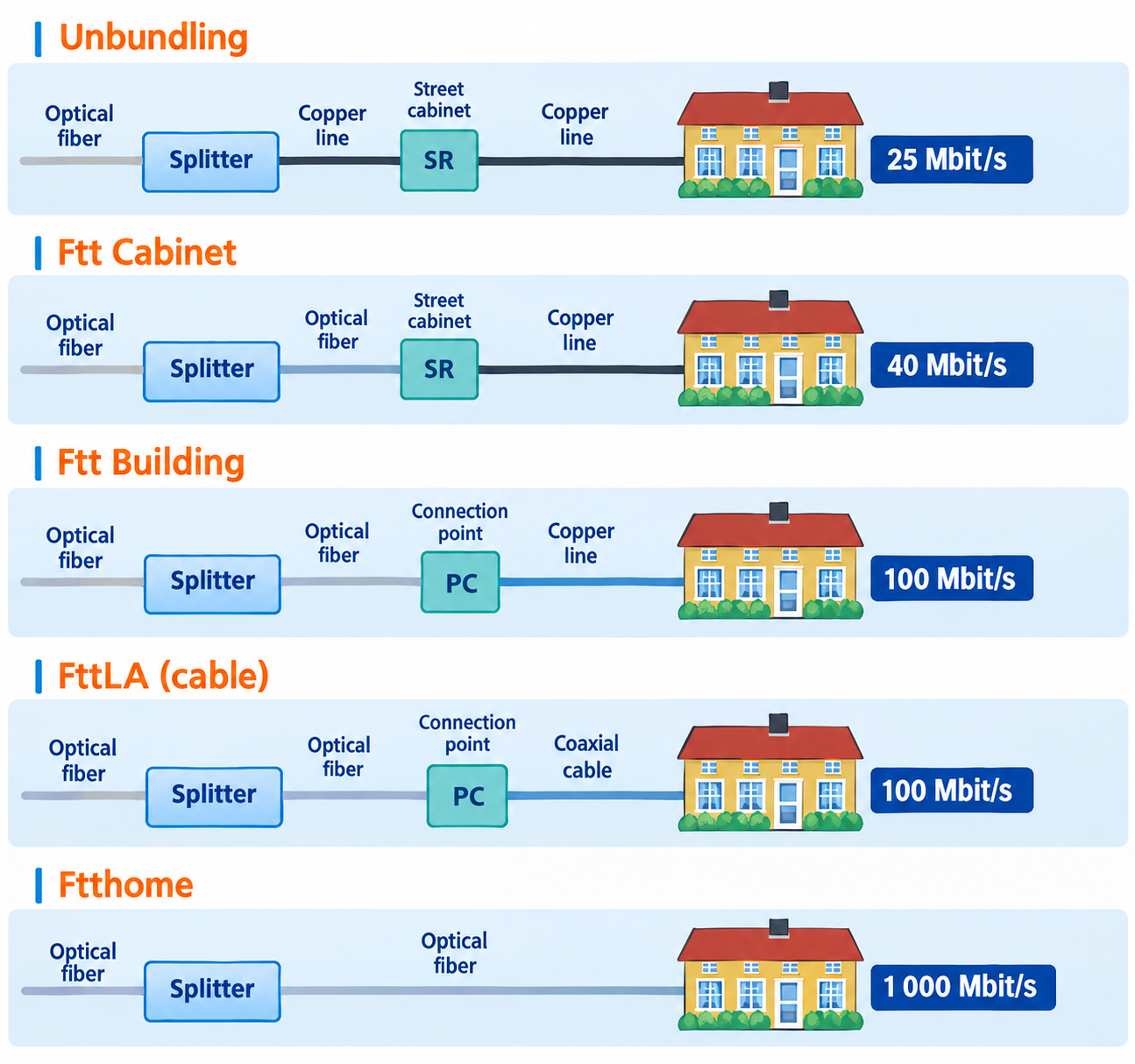
Fig. 6 — Fiber access network architecture: FTTH, FTTB, FTTN
The roll-out of ultra-fast broadband networks involves bringing fibre-optic cables closer to the subscriber (FTTx — Fibre to the x):
FTTH (Fibre to the Home): the fibre is routed directly to the subscriber’s home. This solution offers the best performance (1 to 10 Gbps). It is the option chosen in France following consultation between operators.
FTTB (Fibre to the Building): the fibre reaches the base of the building, with the final section remaining a copper pair (VDSL2). Speeds of up to 300 Mbps.
FTTN/FTTC (Fibre to the Node/Cabinet): the fibre reaches the local distribution cabinet, with the final section (a few hundred metres) remaining copper-based using VDSL2.
FTTO (Fibre to the Office): dedicated fibre connection to business premises, with guaranteed speeds and an SLA (Service Level Agreement).
a) PON technologies (passive optical network)
In France, operators use PON (Passive Optical Network) technology. The bandwidth of a fibre is shared among several subscribers (32 or 64) using passive optical splitters (without a power supply).
Several PON standards are available:
|
Norme |
Subscribers / fibre |
Downstream flow |
Flow rate (upward) |
|
GPON (ITU-T G.984) |
64 |
2.5 Gbps |
1.2 Gbps |
|
10G-EPON (IEEE 802.3av) |
32 |
10 Gbps |
1.2 Gbps |
|
XGS-PON (ITU-T G.9807) |
64 |
10 Gbps |
10 Gbps (symmetrical) |
|
50G-PON (emerging) |
64 |
50 Gbps |
50 Gbps |
ℹ XGS-PON and symmetry
XGS-PON (XGS = 10 Gigabit-capable Symmetric) enables symmetrical upstream and downstream data rates of 10 Gbps over the same fibre. This is the standard that French operators have been rolling out since 2022 for new installations. Commercial packages labelled ‘8 Gbps fibre’ or ‘2 Gbps fibre’ correspond to XGS-PON connections with partially guaranteed speeds.
4. Satellite connection
Satellite connectivity is used in areas without terrestrial infrastructure (rural, maritime and aviation ‘white spots’).
Two generations coexist:
Geostationary satellites (GEO): orbiting at an altitude of 36,000 km (Eutelsat, SES, Viasat). Data rates of 50 to 100 Mbps, but high latency(~600 ms round-trip) incompatible with online gaming and certain real-time applications.
Low Earth Orbit (LEO) satellites: constellations at an altitude of 500–600 km (Starlink/SpaceX: >6,000 satellites, OneWeb, Amazon Kuiper). Data speeds of 50 to 500 Mbps, low latency (20–40 ms), global coverage. Starlink has been deployed in France since 2021 and is particularly well suited to rural areas without fibre-optic connectivity.
⚡ Starlink and the LEO satellite revolution
The Starlink constellation (SpaceX) has radically changed the satellite landscape: with over 6,000 satellites in low Earth orbit, it offers global coverage with performance levels comparable to ADSL (50–500 Mbps, latency 20–40 ms). In France, Starlink is eligible for funding schemes for areas without broadband coverage. The next generations (Starlink V2, with inter-satellite lasers) aim for speeds of 1–10 Gbps.
5. 4G/5G mobile connection
4G LTE mobile networks (available in France since 2012) and 5G NR networks (available since 2020) provide high-speed wireless internet connections, which can be used as a primary connection (unlimited data plan + 4G/5G router) or as a backup solution. Typical speeds: 4G 20–150 Mbps, 5G sub-6 GHz 100 Mbps–1 Gbps, 5G mmWave up to 10 Gbps. 4G coverage extends to over 99% of the French population (ARCEP coverage obligations).