
B. WEB 2.0, 3.0, 4.0 — CHANGES IN USAGE
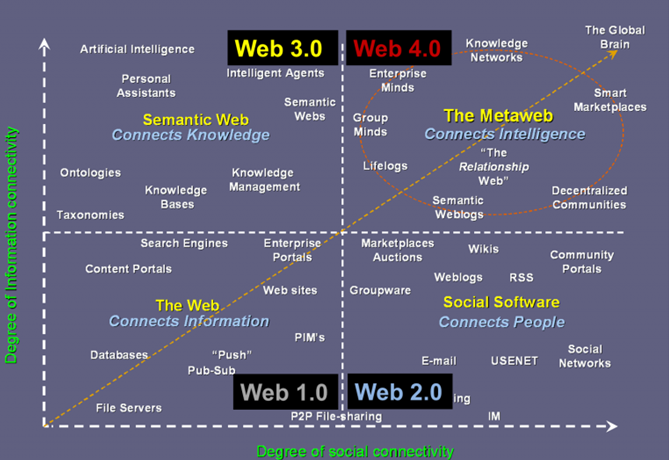
Fig. 3 — Evolution of the Web: Static Web 1.0 → Intelligent Web 4.0
The term ‘Web x.0’ refers to the successive developments of the World Wide Web, not in terms of its technical protocols (HTTP and HTML remain the foundation), but in terms of its uses, business models and capabilities.
The web is based on three complementary dimensions:
· Technological: the convergence of technologies (Ajax, APIs, HTML5, WebAssembly) enabling rich web applications directly within the browser.
· Social: the rise of user-generated content (UGC), comments, sharing and social media.
· Economic: The internet has become an economic platform in its own right (e-commerce, SaaS, the API economy, platforms).
1. Web 1.0 — The static web (1990–2000)
Static HTML pages published by organisations or experts, view-only for visitors. Simple hypertext navigation. Services: email, FTP, Usenet forums, personal webpages. The content is produced by a few and consumed by everyone.
2. Web 2.0 — The Social Web (2000–2015)
A revolution in usage brought about by the emergence of participatory tools.
Web 2.0 is characterised by:
Blogs: websites consisting of posts (posts) organised by date, which are easy to publish and allow interaction with readers (comments).
Wikis: collaborative content management systems where pages can be edited by authorised users. A prime example is Wikipedia (2001).
Social media: Meta (Facebook, 2004), YouTube (2005), Twitter/X (2006), Instagram (2010), TikTok (2016). In 2020: Facebook 2.5 billion, YouTube 2 billion, WhatsApp 2 billion, Instagram 1 billion users.
Mashups and open APIs: integration of third-party services via APIs (Google Maps, Stripe, Twilio). Content from multiple sources is combined to create new services.
RSS feeds: automatic distribution of updates in XML format, enabling content syndication.
ℹ Cloud computing et Web 2.0
One of the key features of Web 2.0 is that all services are available online (cloud computing). Content is created directly online: nothing is stored locally anymore; everything is created, stored, shared and exchanged over the internet. Search engines and collaborative tagging systems make it possible to find information within this vast amount of data.
3. Web 3.0 — The Semantic and Decentralised Web (2015–)
Web 3.0 is characterised by the structuring of the vast amount of information available.
Two main dimensions:
Semantic Web: structuring data to make it machine-readable (ontologies, RDF, SPARQL, schema.org). The aim is for search engines to understand the meaning of web pages, not just the keywords.
Decentralised web (blockchain): decentralised applications (dApps) running on blockchains (Ethereum). Cryptocurrencies (Bitcoin, Ether), NFTs, DeFi (decentralised finance). The aim is to eliminate centralised intermediaries.
4. Web 4.0 — The smart and immersive web (emerging)
Web 4.0 is intelligent: it uses the data it collects to analyse and influence user behaviour through artificial intelligence. Recommendation algorithms (YouTube, Netflix, TikTok), conversational AI (GPT, Claude, Gemini), real-time personalisation, and augmented/virtual reality (Metaverse, AR) are further blurring the line between the virtual and the real.
⚡ Generative AI and the evolution of the web
Since 2022, generative AI (large language models — LLMs) has profoundly changed the way we use the internet: AI-assisted search (Copilot, Perplexity), code generation (GitHub Copilot), content creation (images, videos, text). This development calls into question business models based on traditional targeted advertising and search engine optimisation (SEO).