
K. INTERNET OF THINGS (IoT)
The Internet of Things (IoT) refers to communication between interconnected objects, which can be any everyday item: environmental sensors, vehicles, household appliances, industrial equipment, medical devices, etc.
The networks used for the IoT fall into two main categories:
LPWAN (Low-Power Wide-Area Network) using unlicensed ISM frequency bands at 868 MHz (Europe) or 915 MHz (North America): Sigfox and LoRaWAN technologies, optimised for low power consumption and long range.
Cellular LPWAN variants of licensed networks (2G, 3G, 4G, 5G) such as LTE-M (eMTC) and NB-IoT (Narrowband IoT), deployed on operators’ existing infrastructure.
1. Technologies IoT
|
Identification |
Tools/Sensors |
Connection protocols |
|
Radio-identification (RFID) |
Accelerometer |
Bluetooth / BLE |
|
Surface acoustic wave |
Gyroscope |
Wi-Fi / Wi-Fi HaLow |
|
DNA / barcode |
Miniaturised sensors |
ZigBee (IEEE 802.15.4) |
|
NFC |
Nanotechnologies |
Z-Wave / Thread / Matter |
2. Components of an IoT system
· A physical or virtual tag to identify objects and locations (RFID, QR code, IP address).
· A way of reading physical tags or locating virtual tags (RFID reader, GPS, Wi-Fi/mobile triangulation).
· A mobile device or embedded device (mobile phone, MCU, SBC) with embedded software.
· A wireless network (LPWAN, Wi-Fi, 4G/5G) enabling communication between the device and the server.
· An IoT server or cloud that stores and processes data (AWS IoT, Azure IoT Hub, Google Cloud IoT).
· A display or dashboard for viewing data (mobile app, web dashboard).
3. RFID (Radio Frequency Identification)
The RFID system is a passive network that is activated when a reader is present. It consists of radio tags (chip + antenna, negligible in size and weight) and readers. As the tags pass by, the readers activate them within their range by supplying the necessary power. The wavelength used (from 125 kHz to 5.8 GHz) determines the range (up to 200 m) and data rate. Applications range from tracking objects and living beings to access control.
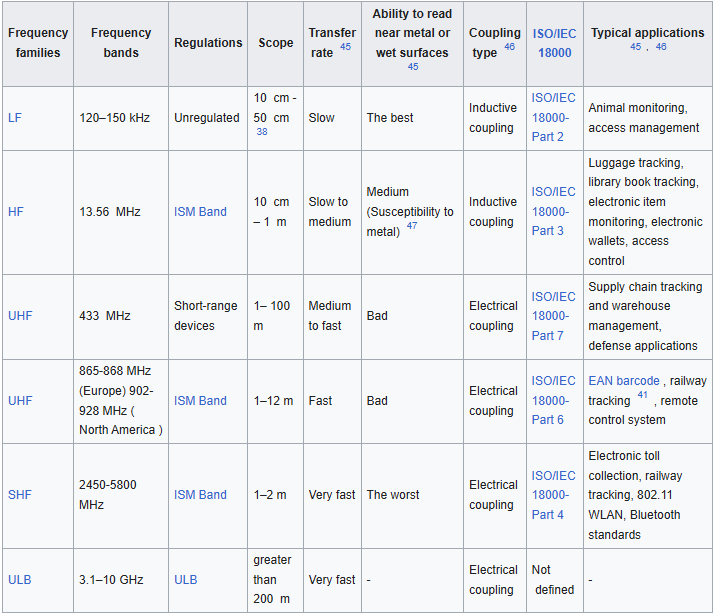
Fig. 11 — Characteristics of RFID technologies by frequency band (Source : Wikipédia)
4. NFC (Near Field Communication)
NFC uses RFID standards, but in this case the reader is a mobile phone and communication is two-way. The range is approximately ten centimetres. The communication frequency is 13.56 MHz and the data rate ranges from 106 to 424 kbit/s.
Three operating modes:
Card emulation mode: the SIM card stores encrypted information (access control, contactless payment, ticketing).
Peer-to-peer mode: two mobile devices exchange information (contacts, photos, videos).
Reader mode: the mobile device reads contactless cards or RFID tags.