
E. ATM — ASYNCHRONOUS TRANSFER MODE
ATM (Asynchronous Transfer Mode) was introduced in the 1990s as the technology of the future. It enables the transmission of voice, video and data at high speeds (25, 155 and 622 Mbps) over long distances. ATM shares the characteristics of packet switching in that each cell contains a field in its header that identifies the connection. As with packet switching, ATM supports variable-rate communications and offers a degree of flexibility in allocating bandwidth to connections.
1. ATM cell format
The decision to transmit data in small, fixed-size packets is a key feature of ATM: it is this principle that enables a significant increase in data rates, as the small packet size drastically reduces transit times. ATM divides data into units known as cells. Each cell is 53 bytes in size: 5 bytes for header information and 48 bytes for the data itself.
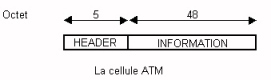
Fig. 6 — Structure of the ATM cell (5-byte header + 48 bytes of data)
The cell contains routing information in its header, based on the concepts of virtual channels and virtual circuits:
Virtual Channel (VC): a concept relating to the unidirectional transfer of cells that share a unique identifier, the VCI (Virtual Channel Identifier).
Virtual Path (VP): a group of virtual channels sharing a common identifier, the VPI (Virtual Path Identifier).
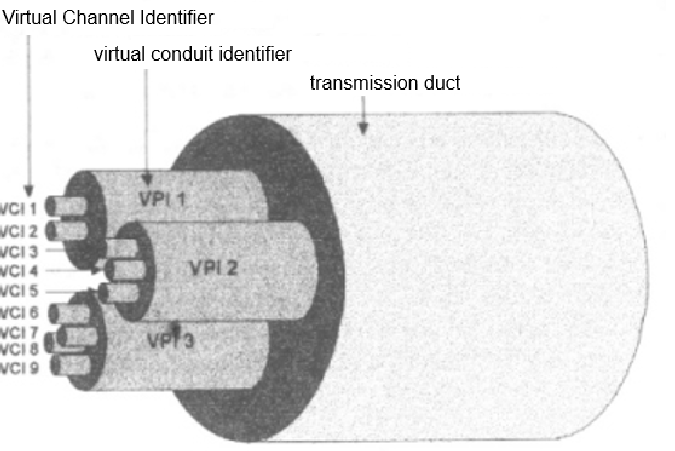
Fig. 7 — Relationship between VCI (virtual channels) and VPI (virtual ducts))
Cells pass through ATM networks via ATM switches, which analyse the header and direct the cell to the appropriate interface. There are two types of interface: NNI (Node Network Interface) between two switching nodes, and UNI (User Network Interface) between a user and a switching node. ATM combines the advantages of circuit switching with those of packet switching.
2. Services ATM
ATM provides for five different service classes depending on the nature of the traffic to be transmitted:
|
Service |
Meaning |
Typical use |
|
CBR |
Constant Bit Rate — fixed bit rate with time constraints |
Circuit emulation, uncompressed video |
|
VBR-RT |
Variable Bit Rate Real-Time — variable bit rate with time constraints |
Compressed audio, video conferencing |
|
Very high bit-rate, near real-time |
Variable Bit Rate (Non-Real-Time) — variable bit rate with no time constraints |
Frame Relay interconnection, guaranteed CIR |
|
ABR |
Available Bit Rate — variable bit rate, optional guaranteed minimum bit rate |
Interconnection of local area networks |
|
UBR |
Unspecified bit rate — no service guarantee |
Best-effort data transfer |
In CBR and VBR, resources are reserved, unlike in ABR and UBR. Traffic descriptors are used to configure the connection: PCR (Peak Cell Rate — peak data rate), SCR (Sustainable Cell Rate — average data rate), MBS (Maximum Burst Size — maximum number of cells allowed to be transmitted at the PCR), CDV (Cell Delay Variation) and CLR (Cell Loss Ratio).
⚠ ATM — obsolete but replaced
ATM was widely deployed in operators’ core networks (backbones) during the 1990s and 2000s, particularly for carrying ISDN signalling and DSL connections. It has gradually been replaced by MPLS and Ethernet in optical networks. ATM remains in use in xDSL infrastructure (ADSL/VDSL) as a transport protocol on the local loop and in certain cellular networks.