
D. TCP/IP (IPv6)
With the convergence of computing, audiovisual technology and entertainment, combined with the needs of businesses, the number of addresses available under the IPv4 protocol (2³² = 4.29 billion) has been exhausted since 2011. The IPv6 protocol (also known as IPng, short for IP new generation) offers greater flexibility and efficiency. It resolves the address shortage and provides new features.
The main improvements of IPv6 compared to IPv4:
· IPv6 uses longer addresses than IPv4. They are encoded using 128 bits and provide 2¹²⁸ = 3.4 × 10³⁸ possible addresses, which is approximately 4.3 billion times the square of the number of IPv4 addresses.
· Simplification of the datagram header: the basic IPv6 header comprises only 8 fields, compared with 14 for IPv4, enabling routers to process datagrams more quickly and improving their throughput.
· Greater flexibility with options: the mandatory fields in the previous version are now optional (extension headers), allowing routers to ignore options that are not intended for them.
· Greater security: authentication and confidentiality (IPsec) are built into IPv6 by default (whereas they are optional in IPv4).
· Automatic address configuration (SLAAC — Stateless Address Autoconfiguration) without the need for DHCP.
1. Format of an IPv6 datagram
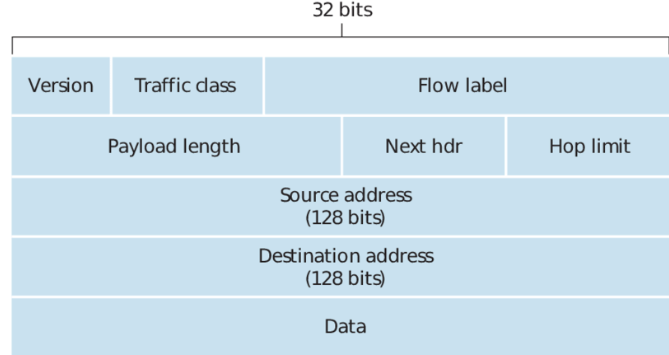
Fig. 5 — Format of an IPv6 datagram (simplified 8-field header)
2. IPv6 addresses
The dotted decimal notation used for IPv4 addresses is no longer used. IPv6 uses a hexadecimal notation, in which the eight 16-bit groups are separated by colons, for example: 1fff:0000:0a88:85a3:0000:0000:ac1f:8001
Rules for abbreviations:
· It is permissible to omit between 1 and 3 leading zeros in each group of four hexadecimal digits. Thus, 0000 may be written as 0.
· A single sequence of one or more consecutive groups of 16 all-zero bits may be omitted, whilst retaining the colons on either side (double colon::). This shorthand may only be used once in an address.
· Thus, the address 1fff:0000:0a88:85a3:0000:0000:ac1f:8001 can be abbreviated to: 1fff:0:a88:85a3::ac1f:8001
📄 IPv6 compact notation
The IPv6 address 2001:0db8:0000:0000:0000:0000:0000:0001 can be written as 2001:db8::1. The loopback address (equivalent to 127.0.0.1 in IPv4) is written as ::1. The null address is written as ::. When an IPv6 address is used in a URL, it must be enclosed in square brackets: http://[1fff:0:a88:85a3::ac1f:8001]/index.html.
3. Types of IPv6 addresses
Different types of IPv6 addresses serve specific purposes. These properties are indicated by the address prefix.
· Global unicast addresses (2000::/3): routable addresses on the Internet, beginning with 2 or 3. The 2001::/32 range is allocated for public addresses, and 2002::/16 for the 6to4 transition.
· Link-local addresses (FE80::/10): can only be used on the same Layer 2 physical network; they are not routable. These correspond to the 169.254/16 addresses in IPv4.
· Multicast addresses (FF00::/8): these replace IPv4 broadcast addresses. The prefix FF indicates a multicast address.
· Anycast addresses: assigned to multiple interfaces, the packet is delivered to the nearest one (used in particular for anycast DNS servers).
· Loopback address: ::1 (equivalent to 127.0.0.1).
4. IPv6 subnets
An IPv6 subnet is a set of addresses that all begin with the same binary sequence. The number of bits in this sequence is written in decimal form followed by a slash (CIDR notation). By convention, organisations are typically allocated a /48 prefix, which allows them to create up to 65,536 /64 subnets. Each /64 subnet can theoretically accommodate 2⁶⁴ interfaces.
⚡ IPv4/IPv6 coexistence — transition mechanisms
The roll-out of IPv6 is taking place gradually alongside IPv4. Several transition mechanisms exist: Dual-Stack (devices support both IPv4 and IPv6 simultaneously), Tunneling (encapsulation of IPv6 within IPv4 packets: 6to4, Teredo, 6in4), and NAT64/DNS64 (translation between IPv4 and IPv6 addresses for communication between purely IPv4 and purely IPv6 networks). By 2025, most major operators and content providers (Google, Meta, Apple) will support native IPv6.
5. Other protocols in the TCP/IP family
GGP (Gateway to Gateway Protocol): enables two gateways to exchange routing information in order to dynamically update their tables. It is useful for long-distance networks. The information carried by GGP consists of pairs of network addresses and distances (the number of gateways to be traversed). A legacy protocol, now superseded by BGP.
SMTP (Simple Mail Transfer Protocol): a standard protocol for exchanging email over a TCP/IP network. It uses port 25 (or 587/465 for secure transmission).
SNMP (Simple Network Management Protocol): enables the collection of data on network operation (see the Administration section). Uses UDP port 161.