
C. TRANSMISSION
Data can be transmitted with or without cables. The cable is the primary medium for data transmission between two networks; the type of cable used varies depending on the type of network.
1. Cable transmission
The most common type of cable used for LAN connections. It is made from pairs of electrical wires, which are sometimes shielded. This cable is used in particular by xBase-T Ethernet technologies. It supports data rates from 10 Mbps (Cat.3) up to 40 Gbps (Cat.8) over distances of 30 to 100 metres.
Coaxial cable: specially constructed and insulated (the central conductor is known as the core), it is capable of transmitting data at high speeds; however, in modern LAN environments, coaxial cable is no longer used. It is still used in HFC cable networks (TV cable + Internet) with DOCSIS technology.
Fibre optics: enables the transmission of huge volumes of data at the speed of light through thin glass or plastic fibres. It is rapidly replacing all other types of cable for long distances and high data rates. It is the preferred medium for corporate backbones, WAN links and FTTH deployments.
Powerline communication (PLC): enables data transfer via existing electrical wiring. In this technology, the signal is transmitted via induction through the electrical phases. PLC adapters plug directly into electrical sockets. The HomePlug AV and IEEE 1901 standards offer speeds of up to 500 Mbps. The latest-generation G.hn (ITU-T) standard reaches 2 Gbps.
2. Wireless transmission
There are several methods of wireless transmission:
Infrared transmission: a short-range technology based on the frequency of light, which uses electromagnetic radiation with a wavelength lying between that of visible light and that of radio waves. It is mainly used for remote controls and short distances. It is rarely used in computer networks.
data into space via high-frequency radio signals in the region of 1,000 megahertz (1 GHz). The data can be transmitted over a terrestrial network via repeaters spaced approximately 40 kilometres apart. These links are used for the WAN backbones of telecoms operators.
Radio waves for mobile networks: use high-frequency radio waves. Antennas are strategically placed across a region to relay the signal from one base station to another. The evolution of mobile networks has led to the 2G, 3G, 4G LTE and 5G generations.
Wi-Fi (IEEE 802.11): is a WLAN (Wireless LAN) network that uses specific terrestrial radio frequencies. The IEEE 802.11 standards have evolved considerably since the first versions: Wi-Fi 4 (802.11n, up to 600 Mbps), Wi-Fi 5 (802.11ac, up to 3.5 Gbps), Wi-Fi 6 (802.11ax, up to 9.6 Gbps), Wi-Fi 6E (6 GHz extension) and Wi-Fi 7 (802.11be, up to a theoretical 46 Gbps). The range varies from 30 to 150 m depending on the environment.
Bluetooth: enables short-range, two-way data exchange using 2.4 GHz UHF radio waves. It simplifies connections between nearby devices by eliminating the need for cables. (Bluetooth is named after the Viking king Harald Blåtan, whose initials are represented in the logo using the runic alphabet.) Bluetooth version 5.x achieves speeds of up to 2 Mbps with a range of 200 m.
WiMAX (IEEE 802.16): is a high-speed wireless data transmission network designed to cover large geographical areas (with a radius of up to 50 km). It was rolled out in the 2000s as an alternative to DSL in rural areas. It has now largely been phased out, replaced by 4G LTE and 5G networks for long-distance wireless access.
Satellite transmission: has the advantage of enabling connectivity in areas that are difficult for other media to reach. A distinction is made between geostationary satellites (GEO, at an altitude of 36,000 km), which offer global coverage but with high latency (~600 ms), and LEO (Low Earth Orbit) constellations in low Earth orbit.
⚡ Starlink and LEO constellations
The Starlink network (SpaceX) is the most advanced of the LEO satellite systems, with over 6,000 active satellites in orbit at an altitude of between 550 and 570 km (target: 42,000 satellites). By 2025, download speeds will reach between 100 and 300 Mbps, with upload speeds of 20 to 50 Mbps, and latencies of 20 to 40 ms — comparable to ADSL. Starlink is now available in over 100 countries. Other constellations are currently being deployed: OneWeb (Eutelsat), Amazon Kuiper, Telesat Lightspeed.
3. Flow units
Network data rates are measured in bits per second (bit/s or bps). The table below summarises the units used in the International System of Units (SI):
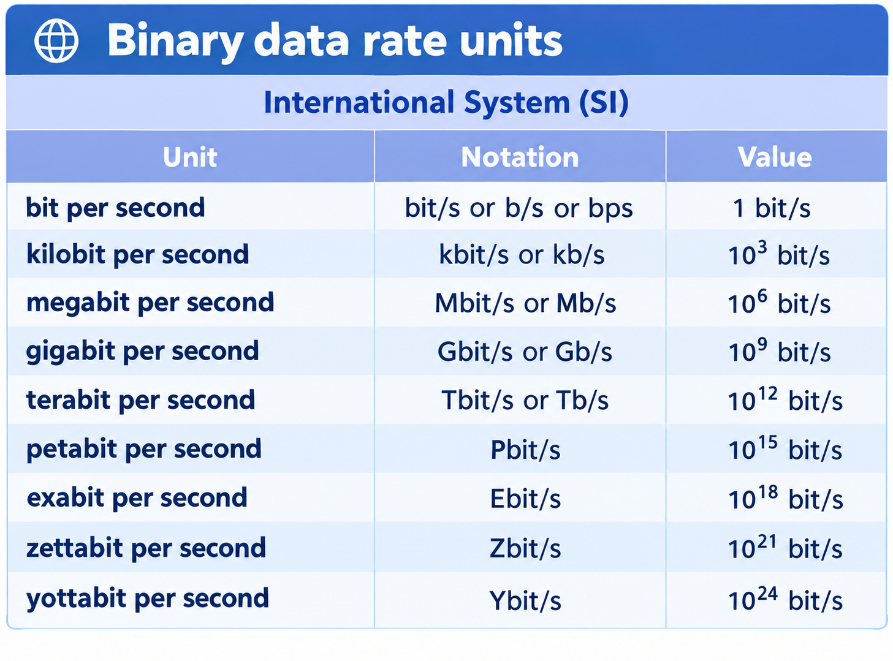
Fig. 2 — Bit Rate Units (Source: Wikipedia)
ℹ Theoretical flow rate vs actual flow rate
The throughput specified by a standard (e.g. 1 Gbps for Gigabit Ethernet) is the theoretical gross throughput. The actual throughput is always lower due to protocol headers, control mechanisms, potential collisions and encryption overhead. In practice, one typically observes 60 to 90 per cent of the nominal throughput on a properly sized network.